THE RISE AND FALL OF LITTLE VOICE Backyard Renaissance
I find The Rise and Fall of Little Voice endlessly compelling and have begun ranting about it to my friends and family since seeing it. A fair enough place to start doing the same to you is to give a basic plot summary.
Little Voice (Megan Carmitchel) is a young girl living in England who copes with the death of her father by obsessively listening to the vinyl records he left her, which they bonded over when he was alive. Little Voice’s agoraphobic tendencies and her constant noise on the record player draws the ire of LV’s mother, Mari (Jessica John), a callous and emotionally abusive woman who has fallen into heavy drinking and constant nights out on the town after her husband’s death. Ray (Francis Gercke), one of Mari’s transient paramours, happens to hear Little Voice singing one evening after relations with her mother, and realizes that she has a singular—and eminently marketable—talent.
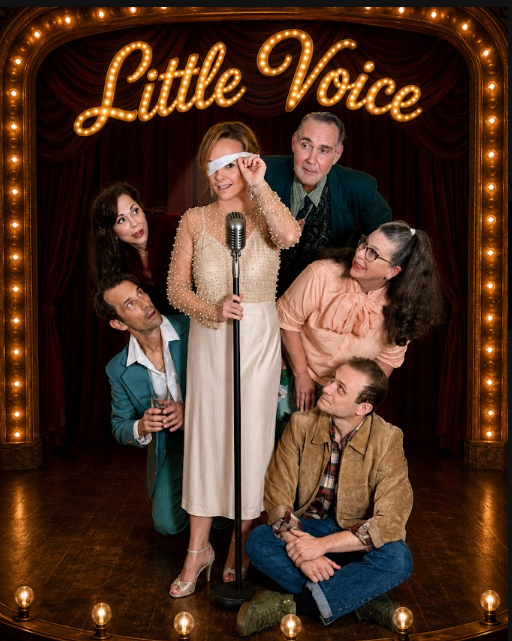
The cast of Backyard Renaissance Theatre’s “The Rise & Fall of Little Voice.”
Photo Credit: Michael Makie
The story proceeds with LV being forced before audiences to massive success, but the strain breaks her. The industry sees her only as a tool to be used to make money, and willingly burns up her talent to make a buck, resulting in her nearly going catatonic from the stress. After Ray sets LV’s house ablaze when she won’t come perform for him because she is through with his abuses, LV is left to belt out the musical homages forced into her throat by her producers, before her love interest, Billy (Layth Haddad), swoops in and saves her life. LV has a final confrontation with her mother, wherein she surmounts her usually timid voice to scream at her mother about how awful she was, and leaves to be with Billy and sings a song on her own, freeing herself from her old life and from fame.
The show was magnificently captivating to me for a number of reasons. First among them being that the performances were wonderful. Carmitchel sold Little Voice’s timidity and reluctance to speak very well, and I was instantly sympathetic to her plight based on her acting alone. Despite that well maintained shy exterior, Carmitchel also had the biggest spectacle in the show, during her 8-minute bombastic classic song medley in early act two. Little Voice is a fiery presence onstage for this musical extravaganza, and though the ultimate purpose of the scene is to show that her managers vampirize her energy for profit, the audience is utterly taken by Carmitchel’s talent and no other moment dazzled like that one did. Any character for whom the show is named requires an actor who can deliver on the promises of the spotlight, and Megan Carmitchel certainly does.
The supporting cast are also very successful in their roles. Jessica John plays a delightfully wicked, villainous, and greedy mother, and though the script only gives the character so much room for nuance, John finds the folds of the character and does not let her solely be the despicable neglectful guardian she nevertheless often is written as. John’s performance is funny, gaudy, and a very distinct contrast to LV’s wordless and sympathetic state. Their juxtaposition shows that grief can destroy people in opposite ways and is quick to tear a family apart.
Francis Gercke is another comedic hit as Ray Say, the man who discovers LV’s talent for mimicking classic songs and first attempts to sell it. This is an appropriate time to mention that the whole cast is laying on THICK British accents throughout the performance. The accents are necessary for the tone and setting of the play as well as the slang implemented in its dialog, and though they are mostly frictionless, they are nonetheless very noticeable. They are quite an easy thing to get used to and add to the comedic scenes, but their intensity is perhaps not as well suited to when the show becomes deadly serious later in the piece.
Gercke has a great casual charisma and is excellent at portraying someone who is pretending to care for his own advantage. Ray routinely manipulates Mari and Little Voice to his purposes throughout the story, and his ultimate punishment feels unsatisfying when viewed in the context of how much damage he did to her.
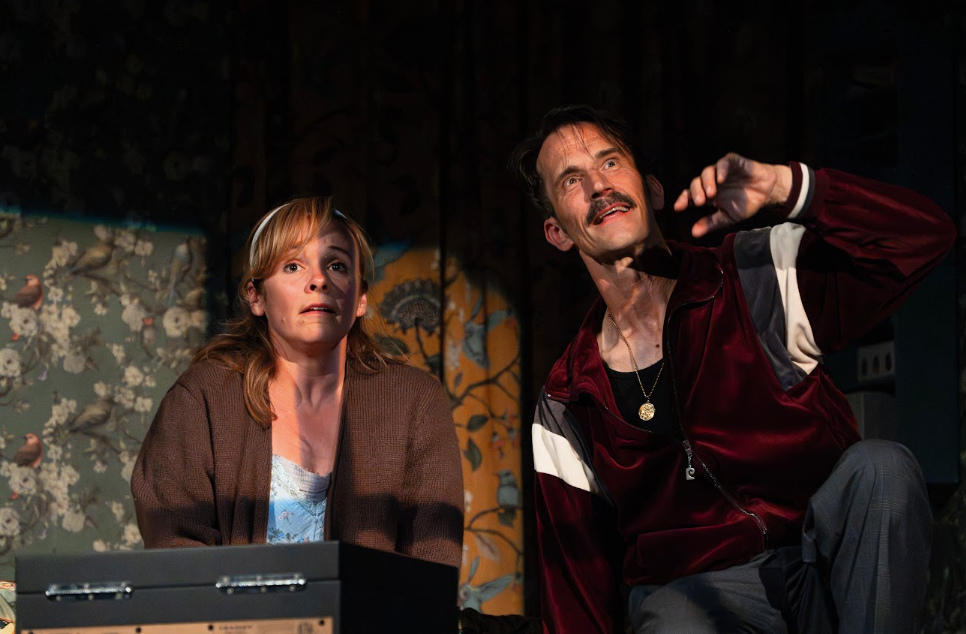
Billy, LV’s love interest and light installation aficionado, is played with soothing warmth and kindness by Layth Haddad, and does a fantastic job at being the one point of light among a supporting cast that uniformly treats Little Voice horribly. Given the suffering LV experiences, all her moments with Billy feel that much more lovely, and you feel a wave of relief whenever you realize that a scene will be a tender moment of connection between the two of them, especially when he swoops in gallantly to save LV from a house fire.
The remaining two characters are humorous additions, though they aren’t given much focus in the narrative.. Mr. Boo (Daren Scott) is a smarmy and ghoulish executive who is successfully enticed by Ray’s scheme to exploit Little Voice’s voice after hearing her sing, and Scott gives him a perfectly sickly presence with always a few too many teeth showing. Sadie (Teri Brown) is a funny neighbor character, who mainly exists so that Mari has someone to speak her ideas to when she would otherwise be alone, and much comedy is made of her minimal vocabulary, usually only responding with the word “okay”. Oddly, this reticence of vocalization aligns Sadie with Little Voice, and she is the most kind character to LV aside from Billy. She even plays a part in Mari’s final abandonment at the end of the play, and LV’s mother’s final lines are appealing for Sadie’s help as Little Voice leaves her, a plea which goes unanswered.
The show is very taken with the musical stylings of the 20th century, and sonic buffs will have much to listen to and excitedly remember the names of. Little Voice’s act is musical impressions of famous songs she has memorized from her hours toiling over her father’s record player, and so the playwright Jim Cartwright gets to flex his encyclopedic musical knowledge when constructing LV’s sets. The music direction by Taylor Peckham was excellent. All of Little Voice’s musical moments were extremely successful as a result and received sonorous lauding from the audience. The arrangements by Evan Hart Marsh are also well worthy of praise for bringing the manifold musical moments to groovy life.
The set design by Yi-Chien Lee is very unvarnished and grounds the story marvellously in the working class setting of Scarborough, North Yorkshire. The dilapidated walls and old furniture inform you about the state of the family and help to establish scarcity. The set is simply and successfully transformed into an intimate nightclub for LV’s singing scenes, with gaudy garlands and limited lighting for flavor. The set design overall supports the storytelling very well.
One thing that sticks in my mind to no end is the show’s dichotomous tone. Like a chord with two discordant notes, the show attempts two conflicting ideas simultaneously, which detract from each other. There is, at once, a very British comedy about a dysfunctional family with a daughter who is a gifted singer, and a gut-wrenching emotional drama about how the music industry will drain grief-stricken, talented people until they are husks. These depleted people will then either die or become zombies, strangers to themselves, kept in chains of their own success.
This latter part of the show is an even more damning condemnation of music executives and talent managers when you take a neurodivergent reading of Little Voice herself. Though the script is absent of labels, LV’s discomfort speaking to others and intense focus on a subject she understands codes her as autistic, whether or not Cartwright completely understood that in 1992 when he penned the script. Per this reading, the music industry will hollow out the individual experiences of neurodivergent people and force them to parrot the attitudes of the mainstream until the stress makes them crack. In any interpretation, Ray Say and Mr. Boo take the records that Little Voice loves, and corrupt them into a force of pain in her life, depriving her of her only token of her father’s memory and destroying all her material possessions as well as her remaining family.
And frankly, these heavy themes do not sit well alongside the fact that the characters ruining Little Voice’s life have silly names like Mr. Boo and Ray Say. The comic aspects of the script can often feel like a distraction from the gravely serious story at play, and the intense and relevant subject matter gives the comedy a strange feeling, like a light shroud over a painfully serious expression. The dramatic work is overall a much more captivating beast than the comedy from which it emerges.
Backyard Renaissance Theatre Company did a fantastic job staging this compelling but tonally inconsistent show. The acting and singing on display are wonderful, and the whole production still brought me a level of emotional investment that is the very best of what theatre has to offer. In a strange way, I am happier that the show is confused in its balance of comedy and tragedy, as a more concrete leaning in either direction would not have been so persistent in my mind. As such, Backyard Renaissance’s production is beautiful in its complexity.