ISAAC’S EYE OnStage Playhouse
Isaac’s Eye is every bit as bizarre, fascinating, and disturbing as it promises.
In writing Isaac’s Eye, Lucas Hnath chose a slimy, uncomfortable historical detail and made it the focal point of a story about ambition, selfishness, and love. I warn you now that I will describe the disquieting historical detail in this review so that the squeamish among you may flee to less gross pastures. I have already inadvertently inflicted nightmares upon many of my friends.
The central historical detail is the unexplained instance where Isaac Newton took a sharp needle and inserted it into his tear duct so that he could press on and alter the shape of his eye. Around this skin-crawling (depending on your sensibilities) incident, Hnath crafts a story of a bitter feud between scientists and a fraught love triangle between two amoral geniuses and an exhausted apothecary, that ultimately asks the question “how far will a person go for their legacy?”
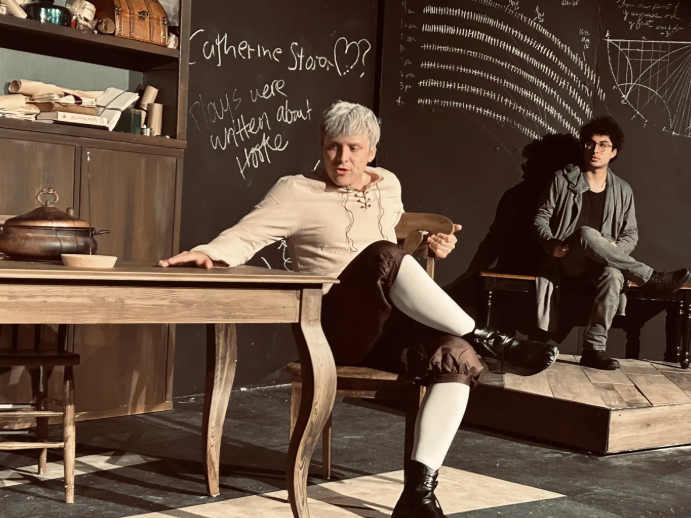
Max Bergstrand, left, and Julián Flores as The Actor in OnStage Playhouse’s “Isaac’s Eye.” (Thomas Ciccone)
The scientist feud in questions concerns Isaac Newton (Max Bergstrand), who expanded the domains of calculus, physics, and visible light, and Robert Hooke (Tom Steward), who pioneered in the fields of biology, engineering, and astronomy. Hooke is framed as an older would-be mentor who sees Isaac’s potential genius and seeks to stifle it before it encroaches on his territory. As a character, Hooke is debauched, incestuous, womanizing, and a great foil to Newton, who is also nevertheless a quite bad person. Newton is an up-and-coming academic mind, who would do anything to prove himself. He applies for a fellowship at Trinity College (which demands celibacy of its recipients) while actively promising his oldest friend Catherine (Kimberly Weinberger) that he will marry her. Newton is constantly sacrificing Catherine’s feelings for his own advancement, and there is a dimension of his relationship with Hooke that suggests Isaac would not be unlike his adversary were he to have all the advantages that Hooke had. The dynamic between Newton and Hooke is what makes up the bulk of the show’s intrigue and its plot, and as such it is lucky to have two capable actors ready to bounce off each other.
Bergstrand and Steward have excellent contrasting energies and their protracted scenes of dialog have a captivating, dancelike quality. The lines push and pull like tides between the two men, everything they say is uttered quickly and urgently, with fanaticism for knowing the truth. It can often feel like someone is reading you an audiobook about disagreeing scientists at 1.75x speed, but the rhythm is very agreeable and the sinusoidal dialog works for the arch-enemy mathematicians.
Bergstrand as Newton is a flawed protagonist that compels the empathy and admonition of the audience. The most prominent character trait on display is desperation. Newton needs to be a renowned scientist and would do anything to achieve that status. He begs and extorts and harms to achieve that desire, and the well-being of those he loves is a bridge he is willing to cross for his own success, which adds a tragic element to watching his exploits; one knows he is digging his own grave.
Steward has great charisma as Hooke, which is lucky because an actor who chose to go all out with the nastiness of the character would leave the audience filled with enmity and vomit. As it is, we recognize the horrible person that Hooke is but understand the charm that afforded him the position of power he manipulates to do truly repugnant things. Despite the character’s villainy, Steward has a joviality and peppy gait that belies the rancidness inside the show’s second great scientist.
Weinberger plays a wonderful Catherine who is intent upon domestic life but finds herself stymied by her chosen paramour’s determination to be Great rather than content. Although Weinberger is an excellent actress and gives the character a tangible melancholy, Catherine cannot escape that Webberian Magdalene status of a potentially complex woman reduced to a central man in her life. The lack of depth in the character, though, cannot be blamed on Weinberger, who gives the character all the profundity she can and makes a Catherine who is very interesting to watch.
The story has a fascinating framing device in the form of an in-universe actor (Julián Flores) who gives us background on Newton and Hooke and tells us that parts of the story are invented for the drama of the play, but that there are kernels of truth in the story, which will be written upon the blackboard walls of the set. This character jumps into the story at certain moments and calls out the scene transitions, but otherwise lingers around watching the story unfold. They serve as a proxy for our observation not only of the events of the show but of the people in history as characters, they literalize the process of dramatizing historical events and making characters out of humans from history on the stage. The choice to tell the story in this way centers the theme of historical recollection and works very well with another great element of OnStage Playhouse’s production: the set design.
Duane McGregor created a set that successfully evokes the time period, Newton’s proclivity for alchemy, and his contributions to our understanding of light. The back wall is a large blackboard upon which the Actor writes the historical truths underpinning the story, and the stage is flanked by large wooden cupboards decorated with containers so ornate the only thing that could possibly be inside them is tinctures of an alchemical variety. The floor displays beams of light-colored wood shooting out from the stage’s entrance to evoke how light fans out after passing through a prism. The whole place feels appropriately Newtonian and bolsters the show’s erudite content and themes of scientific legacy.
If you can overcome the squirming uncomfortability of the basic premise or are just the kind of depraved individual who enjoys the sticking of pointy things into fleshy orifices, Isaac’s Eye at OnStage Playhouse is well worth seeing for the intense, dryly comedic, and oftentimes disturbing scientific feud.
Buy tickets here.