A ROOM IN THE CASTLE MOXIE THEATRE
Any youth theatre—community or scholastic—knows the eternal difficulty of casting a Shakespeare: that the cohort auditioning will have so many more women than the show (cast traditionally) can accommodate. A consternation evolved out of Shakespeare’s seeming allergy to fleshing out his female characters, and doubly so for those he would not kill with expedience. Moxie Theatre’s A Room in the Castle tugs on what threads of female presence there are in Shakespeare’s Hamlet and spins them into a garment of spectacular and intense quality.
The production both retells Hamlet from the perspective of its two underdeveloped female characters and attempts somewhat to transplant that narrative into a modern context of surveillance and spectatorship-as-violence. The result is very interesting to watch, though not utterly cohesive. There are moments where the seams show, especially when the narrative dashes too quickly between moments taken from the text of Hamlet and the show’s alternative original story of kinship between Ophelia and Gertrude. The first words the stranger in front of me uttered after curtain call were something along the lines of “I didn’t quite get it,” but the two women he was sitting with totally did.
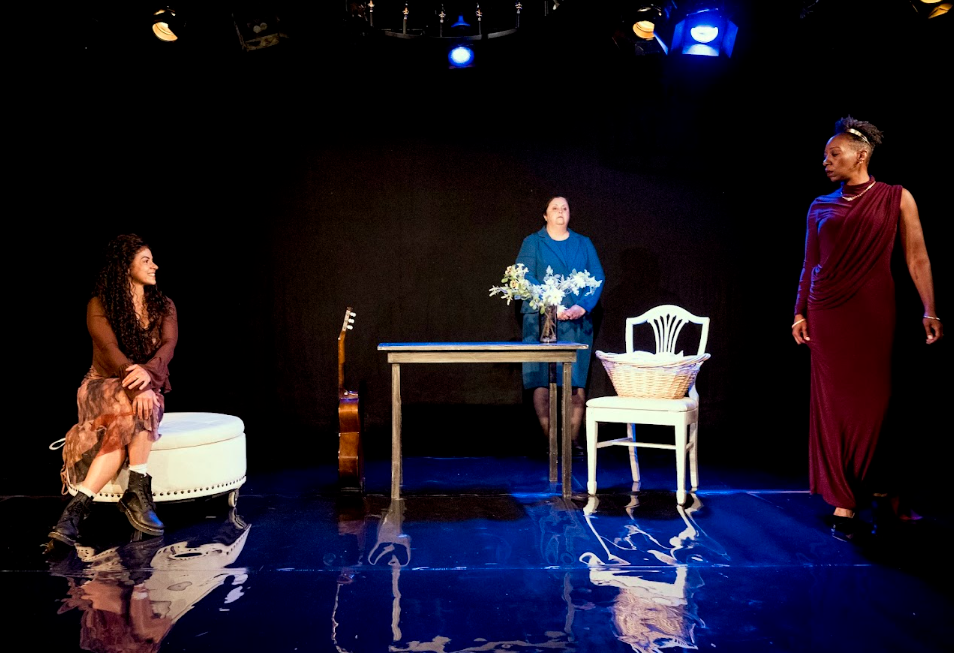
Photo Credit: L-R - Lyric Booth, Vanessa Dinning, and Dianne Yvette Min Moxie Theatre’s “A Room in the Castle” (Jason Sullivan and Moxie Theatre)
The main thrust of the narrative is to take Shakespeare’s discarded women and hold them under the microscope in order to make them protagonists. In this way, the show opens like a work of academic feminist literature examining Shakespeare, but quickly layers in heartfelt relationships and enjoyable scenes where the women of Hamlet get a brief reprieve to discuss their feelings and connect with each other. Out of the lack of characterization in the original text, the playwright fleshes out round characters who want for a world where they do not have to contort themselves around the capricious whims of the powerful men in their lives and can live free from their punitive gaze. Said gaze is literalized by security cameras that constantly bear down on Ophelia and her maid, Anna (an original character made for the show), which only abate when queen Gertrude enters. Scene changes are facilitated by the feed from the security cameras (shown to us on two large screens flanking the stage) flashing through images of the eyes of notable male abusers, rapists, men of power. This harrowing, though on-the-nose literalization of the violence of the male gaze is probably the best touch of the pseudo-modernization the show performs on Hamlet.
The performances were excellent, with Lyric Boothe bringing a wonderful youth and uncertainty to the show’s Ophelia, Dianne Yvette presenting a Gertrude with a stoic regality that gives way to a tender underneath, and Vanessa Dinning portraying Ophelia’s maid and caretaker with an energized protective instinct. Boothe lends her melodic voice to the many moments of song given to Ophelia, whom this show makes into a passionate though timid singer-songwriter, composing the tune that would have been the last words to escape her lips in Hamlet, but not in this retelling. Yvette handles the complexity of her character with remarkable dexterity. Her Gertrude grows to love Ophelia and does everything in her power to protect her, but ultimately cannot escape the gravity well of the men in her life and follows the trajectory of her path in Hamlet, swallowing the poison her husband concocted for her son. Like Shakespeare’s Gertrude, she is destroyed as collateral damage in the petty squabbles of men, but here we see how close she came to freedom from their violent feuds, and how her love of her son drew her inexorably to die by his side.
A Room in the Castle creates a world where Ophelia can survive Hamlet by working with the other women in her life to fake her death and flee to greener pastures, but Gertrude’s years of obeying, agreeing, and assisting enact their price, and not all the women of the show escape.
The lighting design (Stephanie Ma’alona), sound design (Zoe Yahrling) and projection design (Michael Wogulis) do much to tell the story and communicate the constant violence that the men of Hamlet hurl against the women without conscientiousness or reprisal. In moments when snippets of the original Shakespeare text are included to indicate the violence at play, the actual words and actions of the male characters are elided and the intensity of the bright lights and blaring sounds communicate the violations that have been perpetrated.
Though the show is not perfect and its analysis of surveillance could stand to be more relevant to the retelling of the Shakespeare classic, A Room in the Castle is a fascinating story that will enrapture you and send you away with a new perspective on Hamlet and womanhood.