KIM'S CONVENIENCE The Old Globe
More entrancing to me than the hilarious dialog, endearing performances, and well thought-out set design, was the real-life story of Kim’s Convenience’s playwright going from portraying the disillusioned and frustrated son in the original 2011 production to now playing the graying and legacy-worried father in the Old Globe’s current production. Perhaps I am prone to letting a fanciful story draw me away from objective critique, but I felt the most weight from the story of the 85-minute show about an immigrant family trying to make it in Toronto when I combined consideration of the story on display with how the playwright has grown and changed with that story.
The play’s central family emigrated from South Korea where Appa (Ins Choi) had a career as a teacher to discover that the promised opportunities of transplantation were not bountiful for those with broken English. Appa makes a modest living for his family—his wife who is given the name Umma (Esther Chung), and his children Janet (Kelly J. Seo) and Jung (Ryan Jinn)—via the operation of a convenience store which now finds itself at risk of being bought out to facilitate the construction of some condos in its area. As a teen, Jung got into a severe verbal and physical confrontation with his father which left him hospitalized, following which he left the family entirely. The premise is familiar to anyone aware of the 2016 television show based on the 2011 play.
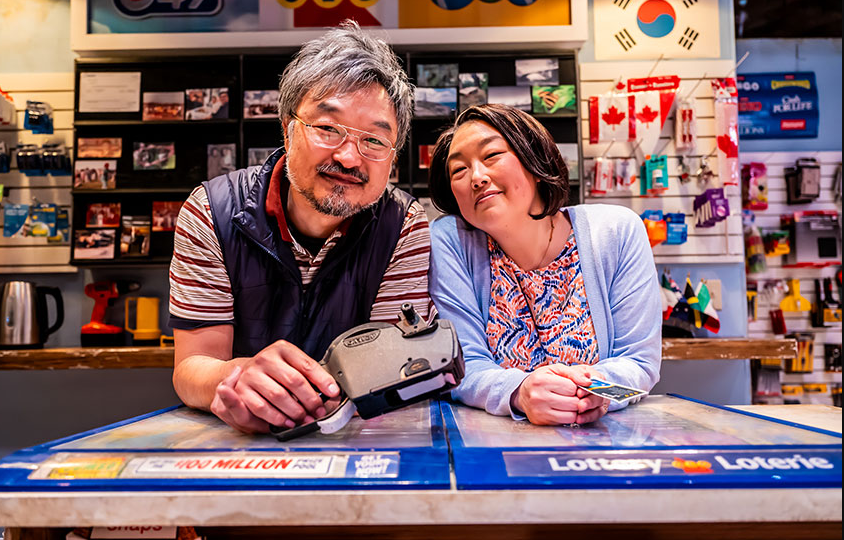
Ins Choi and Esther Chung. Photo by Dahlia Katz.
As a work of theatre, the play is quite successful. It explores now-common themes of inter-generational conflict and the idiosyncrasies and squabbles of immigrant families and families of color broadly. Race relations, economic strife, and family tensions make up the body of ideas the play is reckoning with, and it does so with wit, humor, and humanity.
The standout performances were those of Ins Choi as Appa (who doubles as the show’s playwright) and Kelly Seo as Janet. The struggle between these two over Appa’s desire for her to make the store a family business fighting with Janet’s wish for independence and ever-present youthful desire to escape the black-hole orbit of her parents. Their dynamic is a delight to watch and both actors bring their A-game to both the serious moments and the comedic dialog.
Brandon McKnight also deserves praise for his portrayal of the ensemble cast, revolving through a series of distinct characters that serve to propel the plot forwards or allow the playwright to comment upon the racial prejudices of older Korean immigrants. McKnight does an admirable job at playing a diverse set of roles and is very charming as Janet’s love interest.
Jung, Appa’s son, and Umma, his wife, have less time on stage to show who they are as a result of the plot being mainly structured around Janet and Appa’s dynamic. As a result, we get to both learn less about them and experience their acting chops less.
The show’s projection design by Nicole Eun-Ju Bell merits acknowledgement for the show’s opening montage where a flurry of images of the family growing up flies across the stage, a choice which is later strengthened by the plot detail that Janet has a passion for photography, lending symbolic weight to the choice to show us life captured through pictures specifically.
The most lingering fascination I had with the show was, again, Ins Choi’s journey from playing young Jung to old Appa as time marched on and productions of this show continued. It warms my soul and delights my mind in a unique way to imagine Choi’s experience siphoning his adolescence in Toronto into a play and having his role in the play mirror his stage of life development, gaining a new understanding of the father character he created by literally stepping into his shoes. The production was strong, but Ins Choi’s singular position growing through the characters in the show cements it as excellent in my mind.