ARCADIA Cygnet Theatre
Arcadia, Arcadia, what is there to say about Arcadia.
Tom Stoppard, in a manner not unlike Shakespeare and Shaw, feels like one of those playwrights about whom everything cogent must have already been said by our thousands of intellectual ancestors. Not to mention the fact that the writers in question are some of the foremost dramaturgical minds in history in the first place. The difficulty in discussing a production of Stoppard’s work is much the same difficulty as staging that production: you must find something new to say.
That which is always new in a modern production of a classic is the cast. This company takes on the panoply of characters admirably. Arcadia is a play about how we uncover and investigate history, and in accordance with this theme, it takes place in two parallel eras. The first is 1809, in which the Coverly family go about their aristocratic life with its adultery-based duels and Byronic poetry, and the second in 1993 where a group of scholars does their best to dredge up the lives of the Coverly family in the early 19th century. These two groups are not cast to overlap; there are thirteen characters to be differentiated between the adjoining time periods, inhabited by twelve actors.
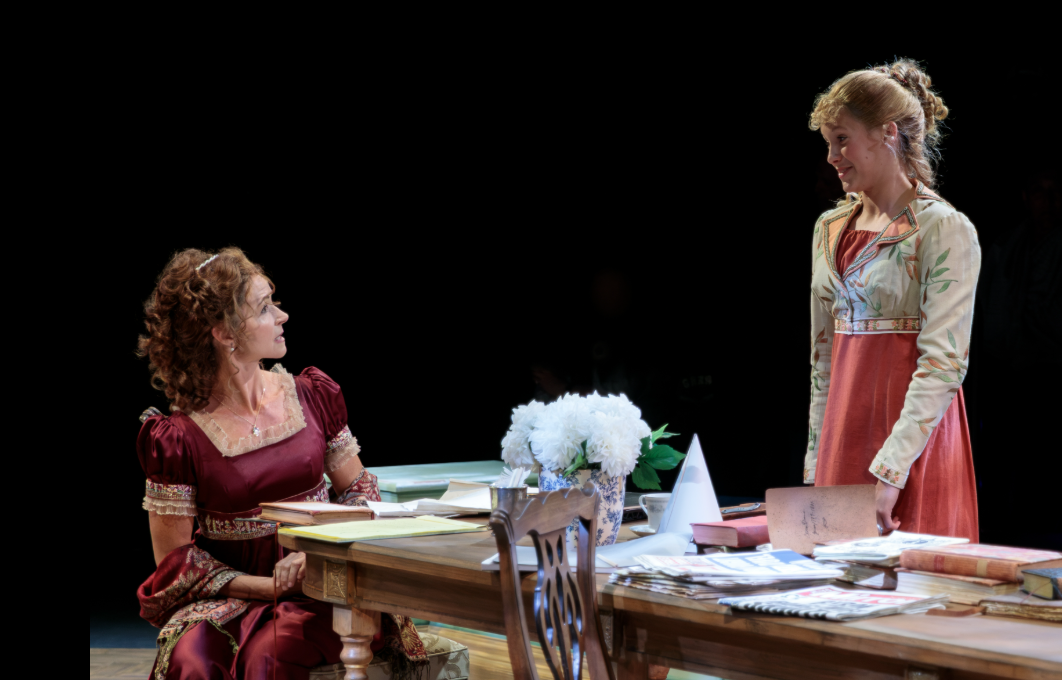
Melanie Lora and Harper Haden
Photo credit: Karli Cadel Photography
Among the regency cast, there are many standout actors. Harper Haden brings excellent youthful curiosity to Thomasina Coverly, the daughter of the Coverly household, whose stately home is the central location of both acts of the play. In the role, Haden is discerning and ambitious, a very compelling up-and-coming scientific mind who wants to gain masterful understanding of the world. Haden sells the character excellently and you are invested in the precocious youth trying to have a bildungsroman amongst all the affairs and high-minded literary feuds of her upbringing. Tutor to Thomasina is Septimus Hodge (Corydon Melgoza), polymath and contemporary of Lord Byron, whose pastimes include interrogating determinism and writing skewering reviews of poetry (which gets him implicated in a duel). Melgoza plays an excellent mentor and is wonderfully charming. Although Thomasina, to my mind, is the real main character of the past sections, Hodge is the character around whom much of the action of the 1800s plot revolves.
Melanie Lora as Lady Croom has an immediate command of the stage as soon as she enters and decisively takes over the scene with her confidence. I would be remiss not to mention Jellaby the butler (Byron LaDue), who is a minor character in the historical timeline but whose actor so perfectly exemplifies the archetype and physicality of a butler that he must be applauded. LaDue is perfect in the role. I have a fondness for butlers.
Of the contemporary-ish players, there are also a number of stellar performances. The two dueling academics of the modern era are Bernard Nightingale (Richard Baird) and Hannah Jarvis (Marti Gobel), who have a classic antagonistic rapport. Nightingale is seeking to prove that Lord Byron shot Ezra Chater (a member of the 1800s cast played by Fred Harlow) in a duel, while Jarvis is looking for evidence of a hermit who lived on the Coverly property until 1834. Their respective studies lead them both to poring over the physical records of the Coverly family archives to bolster their theses, and they chafe immediately over the proper manner of historical scholarship. Their philosophical verbal sparring matches are the stuff people love Stoppard for, and both actors handle the language expertly. Baird in particular has a powerful flair about him that makes it nigh impossible to look away from him when he is strutting his stuff. He is a phenomenal co-protagonist with Gobel.
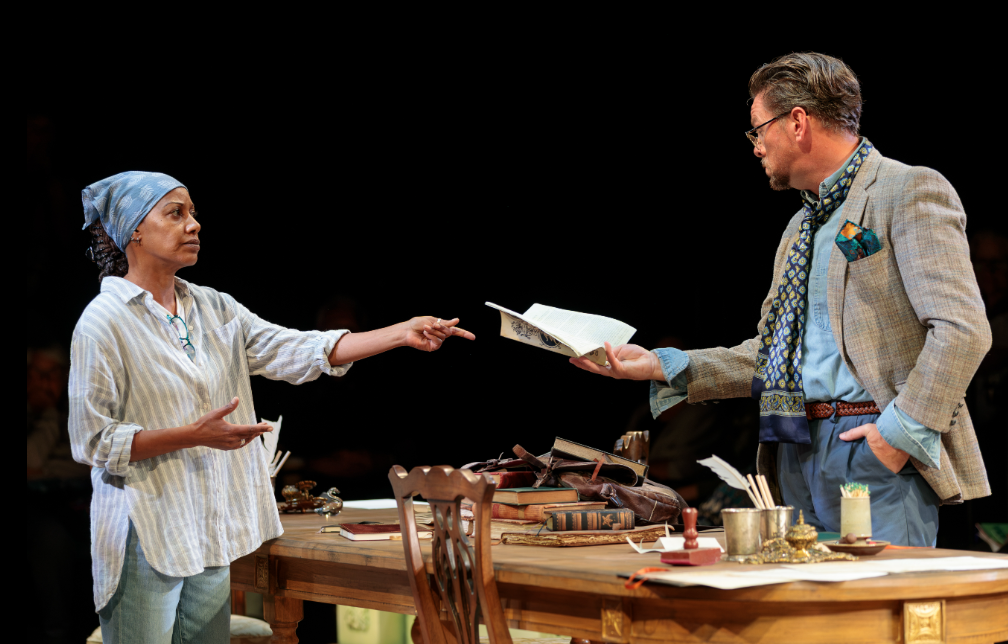
Marti Gobel and Richard Baird
Photo credit: Karli Cadel Photography
Arcadia is a show on a grand intellectual scale. A Ph.D. is advised prior to attendance. Most of the choices that shape the narrative take place offstage; the heart of the storytelling is in the characters’ ongoing deliberations regarding their chosen fields of study. There is a lot of ground this show covers. The characters offer hypotheses and counterhypotheses on determinism, mathematical iteration, the nature of love, fame, history, literature, and more, all while embroiled in an array of complicated romantic connections. In the moment and on reflection, the show offers much to tear apart and attempt to understand. This is a show for those who want to wrestle with weighty philosophical questions and who leave the theatre to promptly do research into the subject matters discussed in the show.
Each person observing this show will come away with a different most impactful theme, but the one most lingering in my mind is how the personalization of history can give us a better insight into what events were actually like in the past, as opposed to clinical historical observation. Stoppard fleshes out and humanizes the people of the 1800s as a counterargument to the common practice of flattening historical figures to tokens on a game board, making decisions according to the forces acting upon them rather than as people living in the same complicated, messy conundrums that affect all humans. We are shown historians investigating a forgotten past in tandem with that past brought to life to show us what is too often discarded as a critical part of history: humanity.
This and a thousand other subjects will greet you inside the doors of Cygnet Theatre at their present production of Arcadia. Go for a profoundly intellectually stimulating evening of theatre.
Buy tickets here.