NORTH BY NORTHWEST The Old Globe
The first word that comes to mind when I think about North by Northwest at The Old Globe is masterful. Some really talented people were allowed to flex their skills in the adaptation of a 1959 Hitchcock classic to the stage.
Like many successful theatrical adaptations, little knowledge of the original story is necessary to enjoy the stage version, but a perfunctory knowledge of North by Northwest the film will help in recognizing the big moments. The original is a classic spy thriller with all of the mid-century staples like fierce government agents, a seedy foreign antagonist, and a femme fatale who falls for the hero in the end. The moments from the film that have especially lasted in the cultural memory are a scene where the protagonist is pursued by an assailing crop duster plane and the climactic final fight on Mount Rushmore.
The Old Globe’s production spins the tropes of the spy thriller into a delicious farce, playing on the hypermasculine insufferability of the ‘50s action hero. Into the plot of the original movie, North by Northwest injects dance pieces, glamorous lip-synched numbers, and lots of hilarious narration to keep the audience up to speed on the convoluted plot.
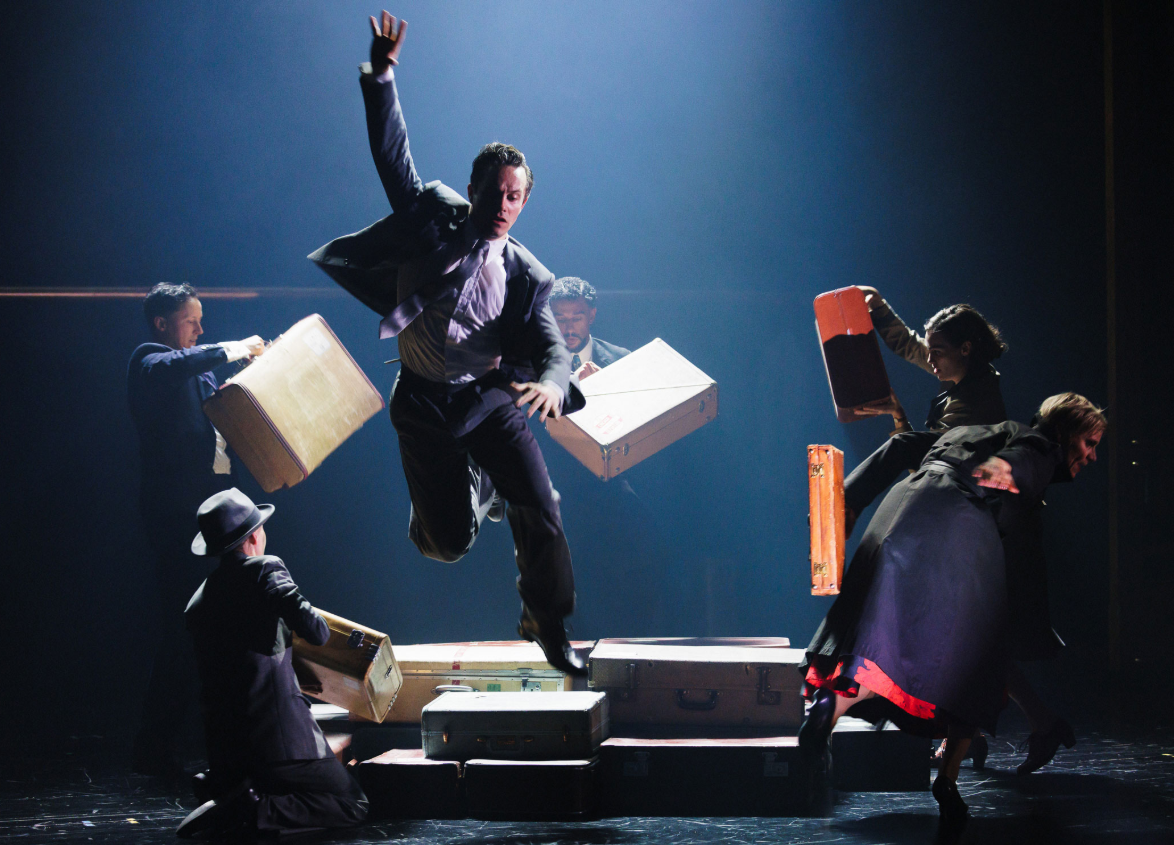
The most evident departure from Hitchcock’s classic is the addition of song and dance numbers to the show, a choice which we all must thank heaven for, no matter our personal feelings on religion. The shimmying moments of movement choreographed by Etta Murfitt are excellent breakouts from the hardboiled attitude of the narrative and complement the satire very well. All seven performers are stupendous dancers, and make these moments luscious with style and fun. Specific attention must be drawn to Danny Collins, portraying the leading man, Roger Thornhill. In Collins’ body, Roger is an undulating adonis on the stage—an incredibly gifted dancer allowed to flex his spasmodic vibration with reckless abandon.
In addition to the dance numbers gifted to us by adapter and director Emma Rice, there are musical moments where the plot stops and the characters lip-synch their hearts out to hits from all across musical history. These songs take a more revue-like character; while they do come at moments of profound emotion and striking drama, they cannot be said to advance the plot. It is both acceptable and necessary to have these flamboyant non-narrative moments, as much of the dialogue is dedicated towards reiterating important plot details so that the audience does not forget who is who and who wants what.
Discussion of the wonderful lip-synching flows quite nicely into lauding the masterful sound design (Simon Baker). The show is full to the brim with dramatic stings and tension-mounting underscore that feels right out of the 1950s and is matched to the action in the show perfectly. The motion of the show and the sounds accompanying it are so well-enmeshed, one could believe a foley artist is behind it all.
Another wonderfully executed technical element is the set design (Rob Howell). Four gargantuan plus sign–shaped pillars occupy the corners of the stage when one enters the theatre. These will become the revolving doors of New York City, the booze-laden walls of a smoky train car, and the impenetrable (or so he thinks) walls of the dastardly villain’s safehouse. The four rotating structures are dazzling in their grandiosity, and the resourcefulness displayed in transforming them into a myriad of different locations is very impressive. In order to adapt the frequent changing of scenery characteristic of a fast-moving motion picture, a litany of suitcases is deployed, each indicating where a scene takes place. The changing of suitcases becomes a running gag, aiming to keep the audience up to speed on what is happening where in the story. For the climax on the perilous cliffs of Mount Rushmore, all the suitcases are piled together to create a ledge from which several critical characters can dangle.
On the subject of using the suitcases to depict where a scene takes place, the play’s need to delicately walk the audience through the somewhat complex plot verges on condescending at times. I’ve no doubt many in the audience were thankful the show was so insistent upon clarifying who the baddies and goodies are, but I felt like the playwright and actors alike were insultingly doubtful of my capacity to understand what was happening onstage. Although the theatre has less tools at its disposal to mitigate confusion than film (what with the doubling of actors and necessity of the audience to imagine a portion of the set), I think North by Northwest went a bridge too far in their preemptive allaying of the audience’s misunderstanding.
As far as how they adapted the moments of action in the antecedent film, there is a very successful translation. The props team and director creatively and artistically rendered a plane chase, a fight atop big presidents’ faces, and the surreptitious invasion of the bad guys’ headquarters. These moments feel intense and energized through the power of compelling narration and excellent melodramatic acting.
On the whole, this performance is riotously funny and visually and auditorially spectacular. North by Northwest represents the full force of dozens of razor-sharp talented people applied to bombastic satire of a 1950s classic thriller.
Buy tickets here.