DIVE BAR TIME MACHINE Blindspot Collective
Due to circumstances that could best be described as my fault, I arrived at Dive Bar Time Machine in a disheveled state and barely had time to rest and meet my neighbors before the performance started. Once the singing and dancing began, it healed my soul from this incident and made me a better person.
Attendance at Dive Bar Time Machine entails receiving and reciprocating an endlessly positive, powerful performance of musical hits from the 1940s to the present, delivered with gusto and pizzazz. This show is made by the dedication and energy of its performers as they wonderfully sing and dance notable numbers from the American sonic canon. For those connoisseurs of music from history (or the trivia-minded), the experience will make for a pleasingly challenging test of recall, but for laypeople and enthusiasts alike it is a deluge of sensory delight.
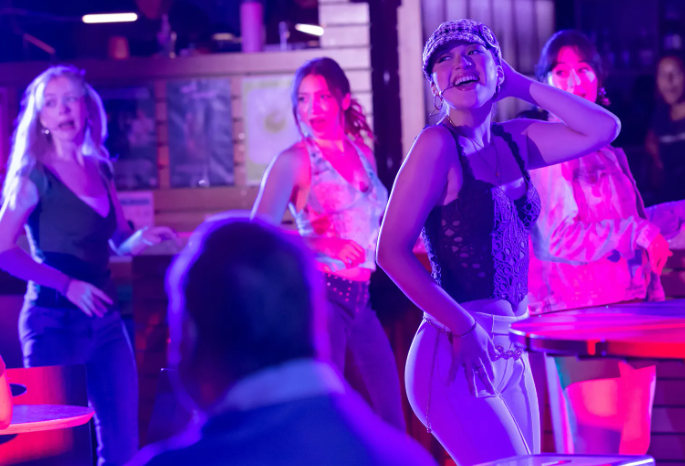
Montse Cabrera and cast in“Dive Bar Time Machine” at The Loft at UC San Diego in La Jolla. (Joe Kao)
The plot is a rather perfunctory element of the experience, with the performance following more in the tradition of musical revue than the jukebox musical: a series of vignettes loosely structured around and tied to the songs being sung, but mostly implemented so that there will be corresponding visuals for the audience to enjoy that evoke the themes of the music. The light storytelling on display usually follows the contours of the songs’ lyrics, usually love, lost love, unrequited love, or partying wildly in search of love. The stories take on an almost Hegelian path: a lovesick character is introduced, an aberration in their desires is presented, and a resolution is achieved or an ambiguous ending is employed, giving way for the next lovesick ingenue to express their situation.
This description is too reductive, as the stories that accompany the song and dance are thoroughly entertaining, engaging, and not as repetitive as they sound, but most of the meaning will arise from what you bring to the performance rather than what the performance brings to you, which is by no means unenjoyable. The passionate tales of love woven in the loose narrative are lovely to absorb, even if the main thrust of the experience is beholding the talent on display.
Speaking of that talent, another reason Dive Bar Time Machine is worth going to is the vocal and rhythmic feats of excellence flaunted by its ensemble of performers. Two standouts for me were Sophie DeLange and Tina Robin, who both wielded fantastic confidence and unshakeable rhythm. However, the success of the show is not so much as a result of some individual talents, but the whole company’s gifts supporting each other’s.
Twelve people execute the set list together while roaming freely through the space and dancing fiercely at an exhausting clip. Their numbers make the whole performance venue feel full with energy, and their up-closeness facilitates connection with the moving music. Although each individual member of the cohort gets their solo moment—and you will no doubt pick your favorites when you see it—the show’s cast is successful as a collective. On display is an exercise in group storytelling, not a host of individual storytellers; no one is alone and every musical gesture is supported by the whole group collaboratively.
As far as how the show holds up to Blindspot Collective’s mission to promote marginalized voices and expose a diverse audience to diverse viewpoints, the show is effective, but somewhat hampered by its dedication to being a dance party before it is a work of social justice. Of course, celebration and the movement of the body have always been integral to the causes of progress for marginalized groups, as while one’s rights may be stripped and one’s visibility limited by the structures that govern, one’s corporeal presence and the joy one takes in one’s community will always belong to oneself. Thus, for any group pressed to the fringes, dancing with one’s people becomes a form of rebellion and of taking pride in oneself; however Blindspot Collective’s interest in exploring this facet of dance and music is not thorough.
There is an undercurrent of community pride through song and dance, but there are few times these critical themes rise above the commitment to being an unfettered dance party. The compilers of the music were certain to center songs by women and queer artists, so the set list is both diverse and good, and the 2000s section of the show is made into an all out love letter to Latin music and artists. The vignette storytelling is also interested in depicting queer stories, which should not be surprising for a group of young musical storytellers (artistic spaces like song and dance have been homes for queer people as they have for every other marginalized group) and is also the bare minimum. Altogether, the political messaging—like most of the show—is what you bring to it. To me, its insistence upon the power of the body for independence and refusal of hegemony was stark, but for an audience member there to jam out to popular songs, it could as easily be devoid of confrontational politics. Dive Bar Time Machine sets out mostly to be, and mostly is, a dance party.
Dive Bar Time Machine is a treat and a frolic through musical history; it is a delightful night of theatre deserving of support and worth braving UCSD parking for. The talented performers deserve your attention (and money), and it is your responsibility to give it to them. In exchange you will receive a pounding 85 minutes of wonderful entertainment with heart, action, and a comprehensive knowledge of American music across the decades. If you are in the area, experiencing this show is a must.
Buy tickets here. You are obligated to.