SCAPIN North Coast Repertory Theatre
Scapin is a laughfest for the ages—literally. The archetype of the schemer that Moliere inscribed into Commedia history was at least as old as Ancient Roman and Greek comic theatre, and tricksters have been getting away with things they oughtn’t since the dawn of time.
This entry into the genre of the trickster farce is excellent, and full of bird noises. Scapin (Paul Slade Smith) is the servant of one of two rich families in an ambiguous Italian province at an ambiguous point in history. When the patriarchs of the families arrive home from a business trip early just as their sons have entangled themselves in love affairs with women of low social class, Scapin’s scheming antics will be the only way to allay the fury of the fathers. From this premise spins out a hilarious tale of melodramatic professions of love, money-making schemes, and lots of bird noises.
The plot is bombastic, goofy, witty, and its sense of humor is sharpened to a point. The show is rife with guffaws, largely due to Bill Irwin and Mark O’Donnell’s snappy comedic writing, which serves the cast’s clowning exceptionally well.
The mood of the show is vibrant, featuring exuberant costumes with their copious garlands and plethora of bright colors, and the set with its handsome houses and colorful spotlights polka-dotting the back wall. Elisa Belzoni’s costume design is perfectly Commedia Dell’Arte, with all of the archetypes embodied with electric creativity. And the set design by the late Marty Burnett equally supports the lively Italian backdrop to the story with its lovely central fountain and the formidable houses of the two wealthy families at the center of the story.
The acting in this production is top-notch, such that each performer merits individual praise for their efforts in creating this elastic farce. Smith is the star of the show; his gangly limbs and braggadocio befit the eponymous schemer and his self-interested deflections excellently. If he cannot be said to command the stage, he is at least its ardent and prolific jester. Smith is perfectly rambunctious, childish, and diabolical as this impish zanni.
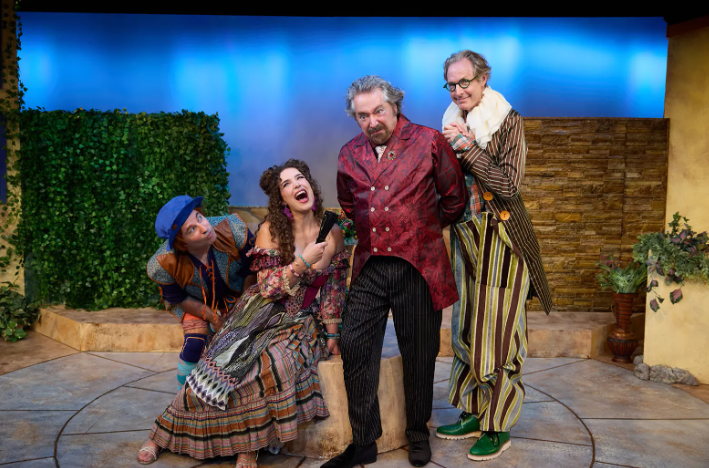
Omri Schein, left, Marie Zolezzi, David Ellenstein and Paul Slade Smith in North Coast Repertory Theatre’s “Scapin.” (Aaron Rumley)
Smith’s limber enormity contrasts quite hysterically with his fellow servant, Sylvester, who is played by the petite and magnificent Omri Schein. Schein is wonderfully goofy and bumbling as Scapin’s out-of-his-depth co-conspirator, and drew me in completely as his efforts to have a passionate soliloquy to himself were routinely stifled by the surrounding antics.
Continuing up the servitude hierarchy, Scapin and Sylvestre are duty bound to obey the sons of two wealthy families: Octave (Miles Blue) and Leander (Tim Frangos). Frangos and Blue (a wonderful band name if ever there was one) are delightful as the boisterous, dim-witted, and easily enamored sons. Their characters are the ones that set the plot in motion, and they are at once hubristic and grovelling for Scapin’s aid in scheming together a way for their partners to be condoned by their fathers. Blue is very noble in his track, with loving and chivalrous flourishes; whereas Frangos takes on the attitude of a jock—with the characteristic voice—and the two cultivate an excellent dynamic.
Onwards and upwards, it is the chirping and miserly fathers who carry the most status in the world of Scapin, which, by comedy law, dictates that they shall suffer the most humiliation. Argante (James Newcomb) and Geronte (David Ellenstein) make excellent rubes as Scapin runs circles of wit around them to advance their sons’ (but mostly his own) interests. Newcomb as Argante plays the two central emotions of his character—stingyness and terror—masterfully well, and his fury at his son’s actions flows effortlessly into his horror at being potentially punished for them.
But while Argante is an incidental player in Scapin’s scheme to help Octave, Geronte is Scapin’s master outright, and therefore Scapin holds a particular vendetta against him. Ellenstein plays the physical and verbal comedy with evident mastery and as much poise as is possible for someone who is repeatedly being hit with a stick. Stuffed to bursting with irascibility and selfishness, Geronte makes a wonderful heel in the show, and Ellenstein embodies that role perfectly.
I will not claim to know the intricacies of the inner minds of Bill Irwin and Mark O’Donnell, nor will I profess to understand Moliere’s aims in crafting the original 17th century iteration of the story, but I can most certainly perceive not only a lack of women within the cast of Scapin, but a lack of interest in exploring those women. Now, the show is not extremely interested in diving deeply into any of the characters’ inner lives, but the issue of the trivialization of women and the reduction of their presence to the desires of men is significant. While Irwin and O’Donnell have done some slight work to make the relationships between the lovers non-draconian, they are not thoroughly successful in clearing up the reductive view on women implanted in the story at one point or another in its birth.
Aside from a few lines where the female love interests ostensibly assert their agency, they have very little impact on the trajectory of the plot (only the men have this right), and if they were replaced with sacks of gold that the sons really wanted to take from their fathers, little would change about the story, except perhaps that Octave and Leander would not be so passionate in their prose when soliciting Scapin’s help. Both sons are in need of Scapin’s assistance specifically to get money from their fathers so that they can pay for either the dowry or the freedom of the ones they desire.
When allowed onstage, the women have great rapport, and the actresses playing Hyacinth (Gabbie Adner) and Zerbinette (Marie Zolezzi) are wonderful in their own regard and in their dynamic with each other. It is merely heartbreaking that they do not get more to do, because Moliere in the first place and Irwin and O’Donnell in the second place were more interested in telling a story of men toying with each other than humanizing the women for whom those men went to extreme lengths.
Adner as Hyacinth matches Blue’s airy lovesickness and plays a wonderful melodramatic romantic who wants nothing more than to throw her arms around her lover and tumble into a happily ever after. She was shipwrecked on her way to meet her father, and was consoled by and drawn to Octave in her suffering, but despairs when she learns that Octave’s father has arranged for him to be married to someone else. It is a classic tale of love, and as it is a classic tale, the woman has little to do but wait for things to be done on her behalf.
Zolezzi as Zerbinette is a more worldly type, although she is so deprived of agency that a sack of coins serves as synecdoche for her until her first appearance at the top of the second act. Nevertheless, Zolezzi is one of the funniest members of cast as the guffawing and world-wise Zerbinette, who was raised by the local Romani people in the town and now has been “rescued” by Leander. It bears mentioning at this moment that another GLARING oversight by O’Donnell and Irwin is the inclusion of the term “gypsy”—a racial slur used to oppress and foment violence against Roma for hundreds of years. Per Scapin, Zerbinette was kidnapped by gypsies at a young age and that is why she is more worldly and her costume shows more skin. I regret to burden this section of this review in which I compliment the excellent performances of Zolezzi and Adner with discussion of all the show’s racial and gender issues, but it colors the presence (or lack thereof) of these characters.
Zolezzi is a fantastic love interest with an immensely charming demeanor and a great outlandish laugh. Adner is a quintessential ingenue who gives the distinct and hilarious impression that she might faint with her love one moment and fiercely profane the name of the person distracting her man from her in the next.
The third and final woman in the show is Nerine (Sophia Oberg), Hyacinth’s servant who spends most of the show bedraggled, chasing the mysterious and elusive Monsieur Pandolphe, whom she cannot seem to find. She is sexualized within sixty seconds of her introduction, but she is afforded the agency to resolve her plot by choices that she makes, which makes her slightly less diminished than the other two women. Oberg is a fantastic exhausted traveller, running in circles in pursuit of someone who may not exist at all.
Rounding out the cast is George (David McBean), a silent pianist accompanying the action of the show and reacting with shock to the dramatic developments. McBean is delightful in the role and overflows with sass, such as when he abruptly stands up from the piano—as the song keeps playing over the speaker system—and leaves to get a martini. George fills what little empty space there is in the show with music and subtle but hilarious reactions, a magnificent addition.
Altogether, Scapin is a romp for all time with a cast of actors who excel in the comedic space, delivering a gut-busting performance that nevertheless is burdened by its mistreatment of women in the narrative. North Coast Rep does spectacular work that is worth supporting, but reflect afterwards on the ways in which biases on the part of the authors manifest in the authors’ work in the context of today’s society.
Buy tickets here.