The Fairy Tale Monologues Riot Productions
The Fairy Tale Monologues is a novel, feminist take on the Brothers Grimm.
The fundamental mission of The Fairy Tale Monologues is to reassert humanity into a set of stories that have had their human-ness stripped away by centuries of focus on the mythological. In this feminist reimagining of Grimm’s fairy tales, the magical is secondary to the human stories magic weaves its way into; wolves are not so much wolves as they are predatory men, magic beans are not so much magic beans as they are quotidian horticultural products that are stigmatized for their perceived status as women’s work, and any flawless heroes from the original tales are reinstilled with the degree of messiness that has always complicated human lives.
Between the complication of classic fairy tales and the impassioned songs, this show owes a great aesthetic and ideological debt to Stephen Sondheim’s Into the Woods, even including many of the same mythological characters as are in Sondheim’s revered opus. But while that older show was invested in taking those stories seriously enough to invest them with unpleasant human realities like violence, adultery, and grief, this story goes even further and addresses how ever-present misogyny and homophobia would color the simplified tales we tell children, were they to be made real.
In this version of a confluence of fairy tales, the Baker’s Wife (Josalyn Johnson) has enough self-awareness to wonder why she isn’t given a name, a courtesy not extended to Sondheim’s iteration of the character. If the show has a secondary mission, it is specifically to unearth a set of complicated, realistic women out of a genre of storytelling where women are often irrevocably wicked or immutable paragons of virtue. This show destroys this binary and invites its audience into a land that is all gray.
The show has a framing device that also reads against that of Into the Woods, by centering a child to whom the stories in question are being told, rather than the person telling them. Little Red (Georgia Filipovitch) reads the stories aloud and asserts the reductive categorizations of women espoused therein, which the female characters will rebut. She sits observing the show and chiming in occasionally with the ways these characters will have their nuances sanded away in the retelling of their stories, before eventually joining the action in the climax. Filipovitch is delightfully sarcastic and biting with her quips and perfectly replicates the attitude of a child at the proper age to be utterly done with their parents’ nonsense. Her character is the one who inherits the landscape of storytelling that frames women well-versed in medicinal herbs as witches and women who harbor homosexual affections as cold, ruthless evil queens, it is in her hands to either let those stereotypes live on or to defy them.
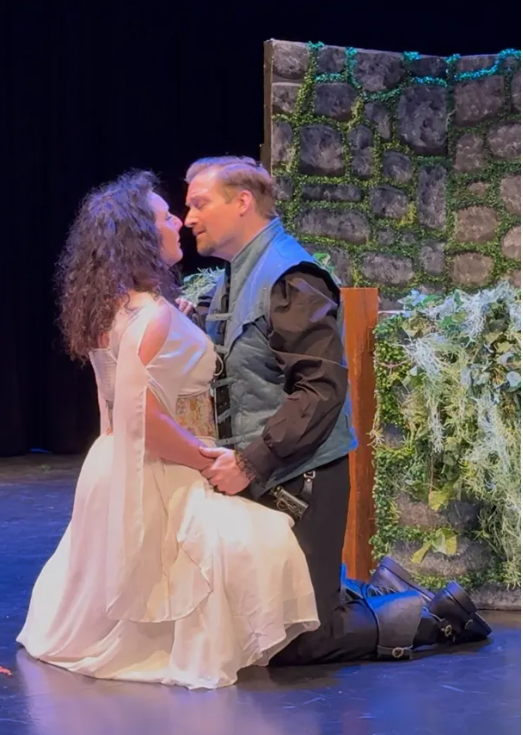
Sarah LeClair, left, and Timothy Benson in “The Fairy Tale Monologues.”
(Melissa Punch)
The story is created out of the many relationships of love and friendship that bind together the main cast of fairy tale characters. The focal character in this web of affections is the witch (Sarah Alida LeClair), who has no magic touch, but rather controls the powerful knowledge of which herbs will elicit what medical responses, including those that can terminate a pregnancy, which is perhaps more dangerous to those in power than her non-existent magic would be. LeClair has a warmth and a caring about her that makes her place as the hearth of the show appropriate. Every other character at one point or another comes to the witch appealing for something, whether it be the Baker (William BJ Robinson) looking for companionship, the Prince (Timothy Benson) coming to woo her, or the Princess (Delia Mejia) arriving with an army to dispatch her. The various loves, friendships, falling outs, and merciless fights the witch engages in throughout the show constitute the meat of both the plot and the thematic; this is a story about humans hurting and healing each other, and the role of a witch is to hurt and to heal. This character, above all, is the one the playwright (also Sarah Alida LeClair) seeks to rehabilitate and bring into a world of sincere analysis rather than one of black-and-white morality.
While it is an often unjust stereotype of feminist art that men will be looked on with inherent and irrevocable revulsion, this story takes as nuanced a read on its men as its women, though the latter group is its main focus. The men are not heartless monsters in this show but humans—humans whose position of privilege and use of violence the author seeks to unpack and examine—but humans nonetheless. Benson as the Prince cares deeply about the people in his life. His relationship with the Princess (who follows the story of Cinderella) is one of platonic friendship. He chooses her among all the women at his ball because he recognizes the pain within her and wants to understand and alleviate it. His real romantic love is for the witch, which the Princess knows and accepts, for her own carnal desires are only for women. Despite the Prince’s empathy, he still resorts to violence as a primary recourse for wrongdoing. When he learns how the Princess’ father hurt her in her youth, he offers in all sincerity to kill him for her. He may have a genuine care for the marginalized and the defenseless, but his worldview is still one in which he can slice and carve his way to justice—a worldview informed by his position of privilege, not just as a white man, but as nobility.
The Baker’s tale is also one of violence, but first and foremost of grief. Robinson is jovial and spry as the young Baker, congenial to his neighbor, the witch, and in love with his wife, though they have not yet had children. His tragedy comes in relation to his wife’s—she is suffering from what we can discern to be mental illness, a permanent feeling of separation and vagueness that leads her to take her own life with a ‘magic’ bean she steals from the witch’s garden, leaving behind her husband and newborn child. In the aftermath of his wife’s death, the Baker falls into a deep depression, neglecting himself and his daughter until the witch decides to take matters into her own hands and take the child for herself.
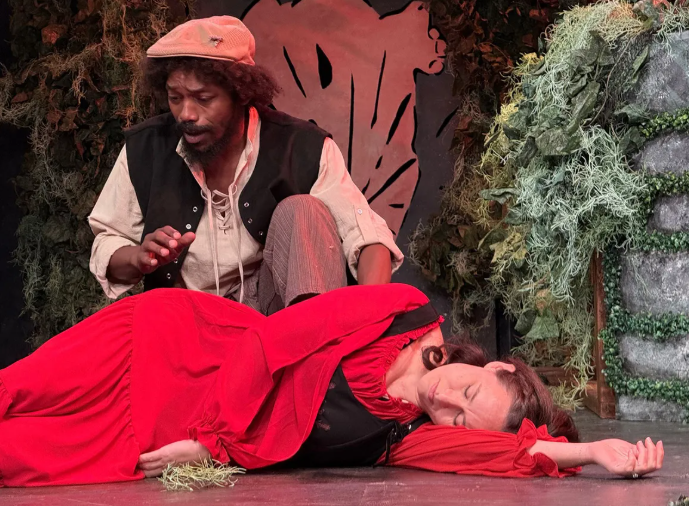
William BJ Robinson, top, and Josalyn Johnson in “The Fairy Tale Monologues.”
(Melissa Punch)
Johnson as the Baker’s wife does the best job of all the cast of playing the complication on conventional fairy tales. She is a deeply flawed character whom we see in her virtue and much of her vice onstage, and her death—one of the only acts of agency she can take—heralds the violent climax of the story. We last see her in a vision telling Little Red not to let her story become muddled in the retelling, to maintain who she was even if it is uncomfortable to tell.
If Johnson is the strongest actor at playing the messy complexity of a fairy tale imbued with humanity, the Princess is the best character at injecting disquieting reality into the world of the brothers Grimm. The Princess suffers primarily by being a lesbian in a world not accepting of her love, but that plight is compounded by the fact that her one true love came into her life as her stepsister when her father remarried. She was brought before the witch to have her ‘wrong’ love erased, which of course the witch had no power to do, so the Princess was separated from her love and eventually found her stepsister drowned by her father’s hand. The Princess’ main accoutrement throughout the show is a harp made of her dead sister-lover’s bones and hair. The show chooses to go dark with this character.
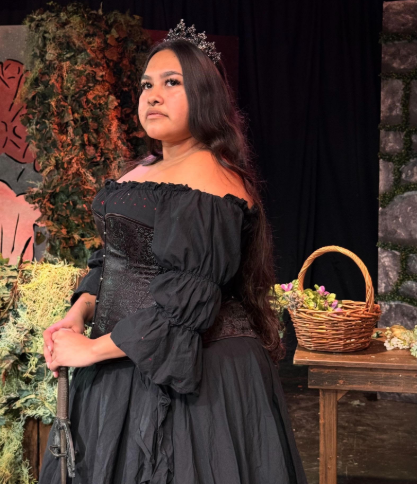
Delia Meija in “The Fairy Tale Monologues.”
(Melissa Punch)
Mejia plays the sadness of her character very well—but her greatest achievement is her singing, which is phenomenal. Unlike Into the Woods, the story is primarily propelled in dialogue, with the songs presenting an opportunity to soliloquize on a character’s severe emotional state. The Princess is given some excellent songs and Mejia thrums with power when she sings. The music in this show has profound emotion, though the body of the work is in dialogue and not in melody. A version of this show where they chose to include more musical numbers would make it more like Into the Woods which it does not need to be. Music has a tendency to strive for the beautiful at the expense of the uncomfortable, and so I prefer the judicious placement of the songs to highlight precise emotions with dialogue making up the remainder of the action.
The Fairy Tale Monologues was an alluring and thought-provoking show that has the capacity to do great things in its future. Though it is too late to catch this particular production, always look out for both Sarah Alida LeClair and Riot Productions for nuanced analysis and shows that force you to reconsider and reimagine the stories we tell.
Riot Productions website.