
Reviewers of Tomorrow: Alumni Reviews
The San Diego Theatre Critics Circle is proud to continue supporting the voices of our Reviewers of Tomorrow winners beyond the annual competition. This page features reviews written by past contest winners as they continue to experience and write about live theatre. We hope you'll enjoy following these emerging critics as they grow, develop their unique perspectives, and share their passion for the performing arts.
Eli Ander-Biegelsen is a Reviewer’s of Tomorrow winner from our inaugural contest, and is currently in college. They are also currently an intern at the La Jolla Playhouse over the summer.
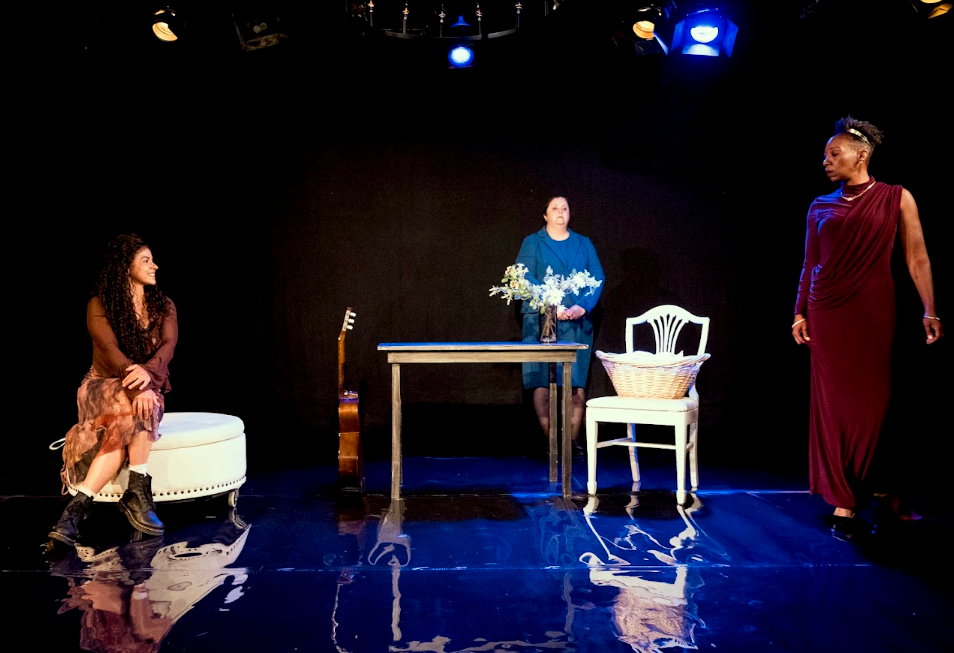
A ROOM IN THE CASTLE - MOXIE Theatre
by Eli Ander-Biegelsen
Any youth theatre—community or scholastic—knows the eternal difficulty of casting a Shakespeare: that the cohort auditioning will have so many more women than the show (cast traditionally) can accommodate. A consternation evolved out of Shakespeare’s seeming allergy to fleshing out his female characters, and doubly so for those he would not kill with expedience. Moxie Theatre’s A Room in the Castle tugs on what threads of female presence there are in Shakespeare’s Hamlet and spins them into a garment of spectacular and intense quality.
The production both retells Hamlet from the perspective of its two underdeveloped female characters and attempts somewhat to transplant that narrative into a modern context of surveillance and spectatorship-as-violence. The result is very interesting to watch, though not utterly cohesive. There are moments where the seams show, especially when the narrative dashes too quickly between moments taken from the text of Hamlet and the show’s alternative original story of kinship between Ophelia and Gertrude. The first words the stranger in front of me uttered after curtain call were something along the lines of “I didn’t quite get it,” but the two women he was sitting with totally did.
The main thrust of the narrative is to take Shakespeare’s discarded women and hold them under the microscope in order to make them protagonists. In this way, the show opens like a work of academic feminist literature examining Shakespeare, but quickly layers in heartfelt relationships and enjoyable scenes where the women of Hamlet get a brief reprieve to discuss their feelings and connect with each other. Out of the lack of characterization in the original text, the playwright fleshes out round characters who want for a world where they do not have to contort themselves around the capricious whims of the powerful men in their lives and can live free from their punitive gaze. Said gaze is literalized by security cameras that constantly bear down on Ophelia and her maid, Anna (an original character made for the show), which only abate when queen Gertrude enters. Scene changes are facilitated by the feed from the security cameras (shown to us on two large screens flanking the stage) flashing through images of the eyes of notable male abusers, rapists, men of power. This harrowing, though on-the-nose literalization of the violence of the male gaze is probably the best touch of the pseudo-modernization the show performs on Hamlet.
The performances were excellent, with Lyric Boothe bringing a wonderful youth and uncertainty to the show’s Ophelia, Dianne Yvette presenting a Gertrude with a stoic regality that gives way to a tender underneath, and Vanessa Dinning portraying Ophelia’s maid and caretaker with an energized protective instinct. Boothe lends her melodic voice to the many moments of song given to Ophelia, whom this show makes into a passionate though timid singer-songwriter, composing the tune that would have been the last words to escape her lips in Hamlet, but not in this retelling. Yvette handles the complexity of her character with remarkable dexterity. Her Gertrude grows to love Ophelia and does everything in her power to protect her, but ultimately cannot escape the gravity well of the men in her life and follows the trajectory of her path in Hamlet, swallowing the poison her husband concocted for her son. Like Shakespeare’s Gertrude, she is destroyed as collateral damage in the petty squabbles of men, but here we see how close she came to freedom from their violent feuds, and how her love of her son drew her inexorably to die by his side.
A Room in the Castle creates a world where Ophelia can survive Hamlet by working with the other women in her life to fake her death and flee to greener pastures, but Gertrude’s years of obeying, agreeing, and assisting enact their price, and not all the women of the show escape.
The lighting design (Stephanie Ma’alona), sound design (Zoe Yahrling) and projection design (Michael Wogulis) do much to tell the story and communicate the constant violence that the men of Hamlet hurl against the women without conscientiousness or reprisal. In moments when snippets of the original Shakespeare text are included to indicate the violence at play, the actual words and actions of the male characters are elided and the intensity of the bright lights and blaring sounds communicate the violations that have been perpetrated.
Though the show is not perfect and its analysis of surveillance could stand to be more relevant to the retelling of the Shakespeare classic, A Room in the Castle is a fascinating story that will enrapture you and send you away with a new perspective on Hamlet and womanhood.

DISCLAIMER: DISCLAIMER: The writer of the following review is currently employed as an intern at La Jolla Playhouse, where this production of Purpose was produced. The opinions expressed in the piece are those of the author writing in a personal capacity and do not represent the views of La Jolla Playhouse.
PURPOSE - La Jolla Playhouse
by Eli Ander-Biegelsen
Purpose is a miracle of theatre at work. There is an inherent power imbalance between an audience member and a work of theatre; the people who collaborated to create and stage this show have poured more energy and thought into the thing than the viewer possibly can. That imbalance is magnified when the work in question won the Pulitzer and the Tony for best play, as Purpose did, given that any constructive criticism one might levy stands next to the opinions of The People Who Choose The Best PlaysTM. Nevertheless, even an attendee entering with no knowledge whatsoever of the show’s accolades will understand that Purpose is something special.
Set in the Chicago home of Solomon “Sonny” Jasper (Cornell Womack), fictional famed Civil Rights icon loosely based on a collection of leaders from the era and especially Jesse Jackson, Purpose indulges in the time-honored theatrical tradition of putting the screws to a family until all of their baggage and what that baggage shows about society is out in the open. In so doing, Purpose places itself in a lineage of family explosion plays that ask questions about the possibility of honest success in America and the damage that generations of a family can inflict on one another. One of the ways in which Purpose carves its own path is by interlacing its interrogation of familial trauma with thoughtful meditation on the parallels between parents and their children and people fighting for the same cause at different times. The show chews intently upon the successes and failures of the Civil Rights movement, and muses as to what the role of the still-living Civil Rights leader is in the modern fight for justice, and whether they can successfully work for progress alongside younger, more queer-inclusive members of the movement. To this Black Studies and Theatre Studies major, the show is irresistable, and anyone with even a cursory interest in either field will be utterly captivated.
At the center of the narrative is the Jasper family, with the strain on the links that connect its members forming the basis of the plot. We are anchored in the story by Nazareth “Naz” Jasper (Matthew Elijah Webb), who is portrayed with immense groundedness and vulnerability, and whose narration helps to guide us into and through the tumultuous family dynamics at play, though which can at times be heavy-handed. Nazareth’s father, Solomon Jasper, is the source from which the family’s strain flows, namely from his disapproval of his sons’ paths in life and general absence from their adolescences on account of his globe-trotting journey promoting the causes he marched for. Nazareth dropped out of divinity school a semester before he was due to graduate and his brother, Solomon “Junior” Jasper (Sean Boyce Johnson) is a politician who was caught embezzling campaign funds, landing him a 30-month prison sentence, though his father’s connections allowed him access to a more cushy prison than most incarcerated Black men would endure. For Solomon Sr.’s part, his fame and involvement in the global movement for Black justice meant leaving his wife, Claudine Jasper (Stephanie Berry) to care for their two neurodiverse (though such labels were not around at the time) children.
The contrast of the new generation finding and defining themselves in the nomenclature of a modern era with greater queer visibility and medical understanding with the old generation still operating in the outdated and often reductive terms of their youth allows for both a captivating analysis of the modern Black family unit and a magnificent linkage of that unit to the difficulty of uniting different generations of fighters for equality. To this quarrelsome quartet, Aziza Houston (Andréa Agosto) and Morgan Jasper (Crystal Dickinson) add a complicating and contrarian flavor. Aziza is a friend of Nazareth’s who marvels at his family’s (or really, his father’s) reputation and has asked Nazareth to contribute his sperm so that she can artificially inseminate herself. Her performance is more low-key than the bluster and bravado of the extremely theatrical Jasper family, but she is nevertheless a very believable and compelling portrayal of a woman becoming slowly disillusioned with a hero and with a friend. Morgan, on the other hand, has become totally folded into the family’s drama and contributes several of the most delicious incensed monologues that we the audience revel in when watching a show of this nature. She is Junior’s wife and holds him and his family responsible for her prospective stint in prison for filing false tax returns. Her bitterness serves as a catalyst to induce the other members of the family to verbal and physical blows, and Dickinson’s performance makes you love to see it.
The final member of the cast, Claudine Jasper, cannot go without remark. She was a standout role, and consistently had the audience laughing when the show chose to be funny, which it did not infrequently—the show is hilarious. However, even otherwise straightforward lines were met with uproarious laughter when in the hands (or tongue?) of Stephanie Berry, who took the character and ran with it until she flew.
An exemplary element of the show is the scenic design by Lawrence E. Moten III. The stage is a bold and defiant blue, an excellent choice for a headstrong family whose bread and butter is agitating for progress. The architecture is beautiful and conveys the poise and history of the family extremely well, creating an excellent frame in which the intensity of the family and its awestruck guest can be unleashed.
Another praiseworthy facet of the show is its willingness to have an asexual protagonist and not feel the need to excessively hold its audience’s hand when explaining the nature of asexuality. A weaker show would have labored extensively to communicate the basics of the identity, whereas this one trusts its audience to more or less catch on and restrains mostly from redundant explanations.
If the show falters anywhere, it is in its length. The show struggles to come out swinging after the lull of the intermission and the opening of the second act suffers as a result. Once the tension mounts again, the show is able to draw the audience back in, but the reintroduction to the world of the play feels overlong and can strain the audience’s patience.
Nevertheless, the show is on the whole a miraculous endeavor, and the celerity with which my audience assumed a standing ovation is a testament to the fact that this is an extremely good show, well-worth seeing if you are in the area. In this instance, the Tony voters and Pulitzer committee selected an apt and spectacular piece of theatre. Purpose is playing through June 7th at the La Jolla Playhouse in La Jolla, California.